What After-sales Support Do PU Sandwich Panel Line Suppliers Provide?
Publication Date: Oct 21, 2026
Discover what after-sales support PU sandwich panel line suppliers offer: commissioning, operator training, remote troubleshooting, warranty coverage, spare parts supply, maintenance & ongoing process support to reduce production downtime.
After-sales support is frequently the deciding factor that separates a smooth, profitable production launch from a prolonged and costly struggle, and this is especially true in the manufacture of polyurethane sandwich panels. A PU sandwich panel production line is a large, capital-intensive, and technically dense system that integrates steel uncoiling and forming, continuous or discontinuous foam dispensing, high-pressure metering, heating and curing, panel pressing or laminating, cutting to length, and stacking. It is not a single machine that can be shipped and forgotten; it is an ecosystem of interdependent equipment, control software, chemical processing parameters, and mechanical tolerances that must work together precisely and continuously, often around the clock. For this reason, the depth, structure, and responsiveness of the supplier's after-sales service become part of the productive asset itself. A strong after-sales framework protects the buyer's investment, protects uptime, and keeps the line capable of producing panels that consistently meet the quality expectations of the downstream market. Understanding exactly what after-sales support is typically offered, how it is organized, and where its real value lies helps a buyer evaluate a supplier not merely on the price and specification of the machinery, but on the long-term relationship that will determine whether the equipment earns back its cost.
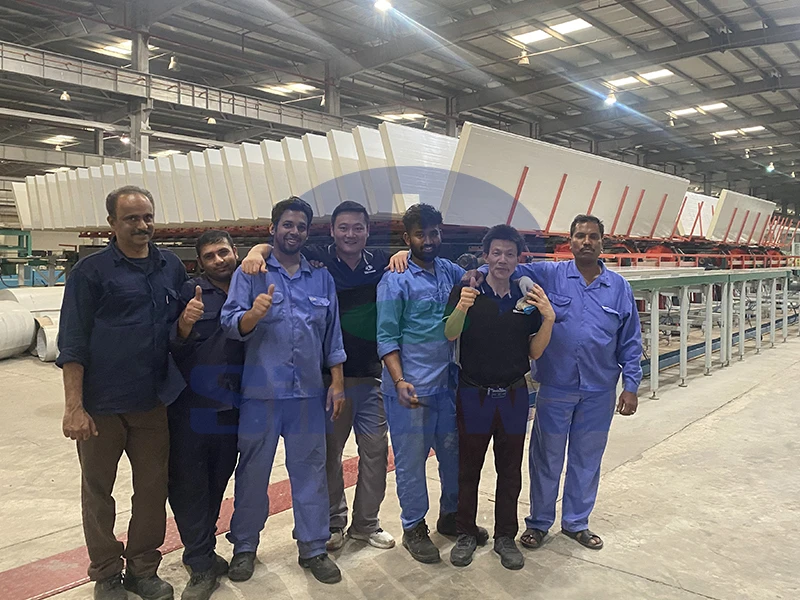
At the most basic level, after-sales support begins with installation, commissioning, and operator training, which together form the critical handover phase. Once the line components arrive at the buyer's factory, the supplier typically dispatches a team of engineers to supervise or carry out the mechanical assembly, the alignment of the forming and pressing stations, the connection of hydraulic, pneumatic, and electrical systems, and the integration of the dispensing and metering units with the curing oven or press. This phase is where the true performance of the equipment is first demonstrated, and where most early problems surface. The commissioning engineers run trial batches of panels, adjust the chemical mixture ratios and the temperatures along the process, verify that the foam core density and adhesion are acceptable, and calibrate the cutting and stacking systems so that dimensional accuracy is achieved. Equally important is the training of the buyer's own operators and maintenance staff. A well-executed training program covers not only how to start, run, and stop the line, but also how to recognize early warning signs, how to perform routine adjustments, how to change formulations safely, and how to carry out preventive maintenance on the metering pumps, mixing heads, heating elements, and cutting blades. The quality of this handover has an outsized effect on everything that follows: a buyer whose team fully understands the line will generate far fewer service calls, will maintain higher output, and will place more trust in the supplier over the years. Conversely, a rushed or incomplete commissioning can leave persistent problems that are later blamed on the equipment when the real gap is in training and documentation.
Beyond the handover, the most visible component of after-sales support is the warranty and its associated repair obligations. Suppliers typically guarantee the equipment against defects in materials and workmanship for a defined period, during which faulty components are repaired or replaced at the supplier's cost. The practical value of a warranty, however, depends on several details that buyers should examine carefully rather than take at face value. One is the scope of coverage, since some warranties exclude consumable and wear items such as seals, nozzles, hoses, filters, and heating elements, which are precisely the parts that fail most often on a foam line. Another is the response mechanism, including how quickly a service engineer can be dispatched, whether spare parts are stocked locally or must be shipped from abroad, and whether remote diagnosis is available to shorten downtime before a technician arrives. A third detail is the procedure for claiming a failure, since some suppliers require photographic evidence, logged error codes, or the return of the defective part before shipping a replacement, and the clarity of this procedure determines how fast the line can be restored. Even after the warranty lapses, most established suppliers continue to offer paid repair services, and the willingness to honor earlier commitments, the transparency of parts pricing, and the availability of genuine replacement components all influence whether the line can be kept in service economically for a decade or more. Buyers should therefore assess the warranty not as a simple promise, but as the opening commitment in a service relationship that will persist for the entire life of the machine.
Remote technical support has become one of the most important and least appreciated dimensions of modern after-sales service for production lines. Because a PU sandwich panel line is controlled by programmable logic controllers and industrial computers, many faults can be diagnosed without anyone physically touching the machine. Suppliers commonly offer a remote support channel through which a service engineer connects to the line's control system over a secure network connection, reads the alarm history, inspects parameter values, reviews production logs, and sometimes adjusts settings or uploads firmware updates directly. This capability dramatically shortens response times, because many common problems can be resolved within minutes or hours rather than waiting for an engineer to travel to the site, which in some regions can take days. Remote support is especially valuable for diagnostic questions, for guidance during complex adjustments, and for verifying that the buyer's operators are performing maintenance correctly. However, effective remote support depends on the quality of the buyer's network infrastructure, on clear agreements about data security and access permissions, and on the availability of staff who can cooperate with the remote engineer in real time. The best suppliers also maintain a documented knowledge base or a library of troubleshooting guides that buyers can consult independently, and they keep records of each line's configuration so that when a call does come in, the engineer already understands the specific machine and its history. In evaluating a supplier, buyers should ask not only whether remote support exists, but how fast it responds, what it can actually do, and whether the connection is monitored and logged.
The spare parts supply system is another pillar of after-sales support that directly determines how long a line stays down when something breaks. A production line is only as reliable as its least dependable component, and on a foam panel line the components under the most stress include the high-pressure metering pumps, the self-cleaning mixing heads, the dispensing nozzles, the heating elements in the oven, the seals and gaskets in the chemical delivery system, and the blades and guides in the cutting station. When any of these fails, production stops, and every hour of stoppage carries a cost far greater than the price of the part itself. Suppliers typically maintain a stock of the most commonly needed spare parts and can ship them quickly, but the level of local warehousing varies enormously. Some suppliers establish regional warehouses or partner with local distributors to hold inventory close to their major customers, while others ship from a central facility, which adds days to the delivery time. Buyers should also clarify whether the supplier can provide complete subassemblies, such as a fully assembled mixing head or a complete metering pump, since these can be swapped out quickly and repaired later, minimizing downtime. The economics of spare parts matter as well, including whether genuine parts are reasonably priced relative to the machine's value, whether the supplier will support the line with parts for many years after purchase, and whether there are recommendations for which spare parts the buyer should stock on site based on the expected frequency of failure. A thoughtful after-sales program helps the buyer build a sensible spare parts inventory, balancing the cost of holding stock against the cost of unplanned downtime, rather than leaving the buyer to discover the vulnerability of the line through painful experience.
Ongoing maintenance support and process assistance form a less obvious but very substantial part of the after-sales relationship, and they are often what distinguish an excellent supplier from a merely adequate one. A PU sandwich panel line is not simply maintained by replacing broken parts; it must also be kept in tune, because the quality of the finished panel depends on dozens of interrelated parameters that drift over time. The chemical formulation, the mixing ratio, the temperature profile through the curing stage, the pressure in the metering system, the speed of the conveyor, and the condition of the mixing head all influence foam density, adhesion, surface finish, and dimensional stability. Suppliers with strong after-sales programs therefore offer periodic maintenance visits, during which engineers inspect the line, recalibrate sensors, clean and service the mixing head, verify the accuracy of the metering pumps, and review the performance data that has accumulated since the last visit. These visits are also an opportunity to refresh the operator's skills, to introduce process improvements, and to identify parts that are nearing the end of their service life before they fail. Beyond mechanical maintenance, many suppliers provide process assistance that helps the buyer fine-tune the formulation for different panel specifications, troubleshoot defects such as voids, poor adhesion, or surface irregularities, and adapt the process when new materials or new products are introduced. Some suppliers even collaborate with the buyer's research and development team to develop custom formulations or to modify the line for new applications, such as panels with different densities, different facings, or special fire-resistant cores, within the bounds of what the equipment can safely handle. This kind of ongoing partnership converts the supplier from a vendor of machinery into a strategic resource that contributes directly to the buyer's competitiveness.
Documentation and training materials are the quieter but foundational layer of after-sales support, and their quality strongly influences how independent and self-sufficient the buyer can become. Comprehensive documentation typically includes detailed operating manuals, maintenance schedules and procedures, troubleshooting charts, wiring diagrams, hydraulic and pneumatic schematics, parts lists with reference numbers, and recommended spare parts inventories. In an ideal arrangement, these documents are provided in the buyer's language, are kept up to date as the equipment evolves, and are accompanied by structured training that may be delivered on site, at the supplier's facility, or through an online platform. The depth of this documentation determines whether the buyer's own maintenance team can handle routine and even moderately complex repairs without calling the supplier for every issue, which reduces downtime and lowers service costs. Many suppliers also offer refresher training, advanced training for maintenance technicians, or new-operator training when the buyer's staff changes, since staff turnover is a constant reality in many factories. Some go further and offer a digital service portal where the buyer can log tickets, track the status of spare parts orders, view service history, download manuals and firmware, and access the knowledge base. The presence and quality of these resources signal a supplier's long-term commitment, because they require real investment to produce and maintain, and they only pay off if the supplier expects to serve the customer for many years. Buyers evaluating a supplier should therefore look beyond the machine's specifications and ask to see sample documentation, to understand the training curriculum, and to assess how easily their own staff can become competent and independent users of the line.
Finally, the true measure of after-sales support is not any single service but the responsiveness and accountability of the entire support organization, which is best assessed through the buyer's actual experience and through the supplier's behavior when problems occur. The most reliable indicator of future service quality is the track record of existing customers, so buyers are well advised to ask for references and to speak directly with other operators of similar lines about their experiences with response times, the competence of engineers, the availability of parts, and the fairness of pricing. It is also instructive to observe how the supplier behaves during the negotiation and installation phases, because a supplier who is responsive, transparent, and proactive before the sale is far more likely to be the same after the sale. Several structural factors influence responsiveness as well, including whether the supplier maintains a dedicated after-sales department with its own engineers and budget rather than sharing staff with new equipment sales, whether service staff are available around the clock given that production lines often operate in shifts, and whether there are clear escalation paths and service level commitments for different categories of problems. Buyers should also consider the long-term viability of the supplier, since a company that may not exist in a few years is of little value as a service partner no matter how good its promises, and the availability of after-sales support is one reason why stability and reputation matter so much when selecting a line supplier. In the end, the right after-sales support turns a complex and intimidating piece of capital equipment into a dependable, productive asset, and it is the combination of responsive remote support, stocked spare parts, competent commissioning and training, honest documentation, and a genuine commitment to the customer's ongoing success that ultimately determines whether the PU sandwich panel line delivers its full potential over a decade or more of service.
Tags: pu sandwich panel line, pu sandwich panel line manufacturer, pu sandwich panel line supplier, china pu sandwich panel line, pu sandwich panel line for sale