Can A PU Sandwich Panel Line Produce Cold Room Dedicated Sandwich Panels?
Publication Date: Oct 21, 2026
Yes, with proper raw material tuning, edge profiling upgrades and strict quality control, standard PU sandwich panel lines can produce reliable cold storage insulated panels.
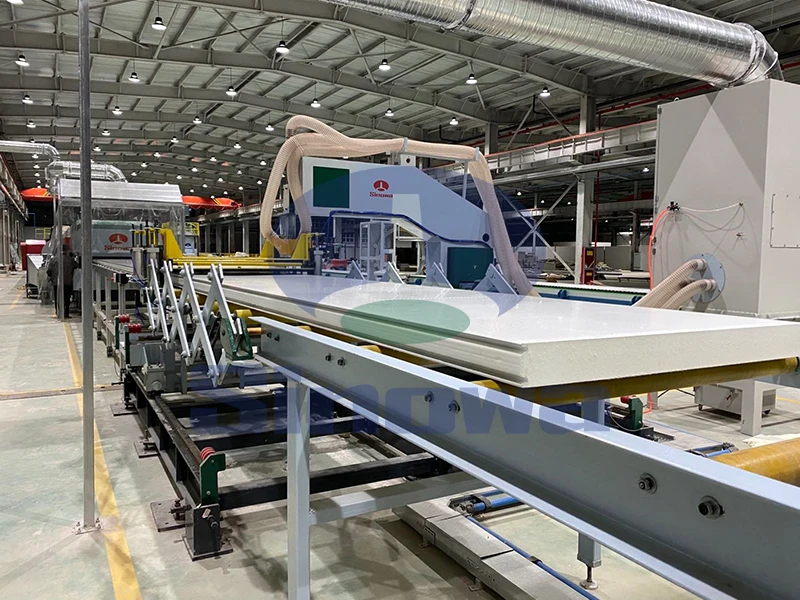
At the core of modern cold storage construction lies a seemingly simple component: the insulated sandwich panel. Two thin sheets of metal facing, usually galvanized steel, painted steel, or occasionally aluminum or stainless steel, enclose a thick core of rigid polyurethane foam. The entire cold room — the walls, the ceiling, and often the floor — is assembled from these panels, which are joined edge to edge to form a sealed, thermally efficient envelope. Given that both general architectural sandwich panels and cold room panels share the same fundamental anatomy — metal skins bonded to a polyurethane foam core — a natural question arises: can a production line built for ordinary PU sandwich panels also manufacture the dedicated panels used in cold rooms? The answer is a qualified yes, but the qualification is substantial. While the underlying technology is shared, cold room panels demand a level of precision, raw material purity, chemical formulation, and production discipline that pushes an ordinary line to its limits. This article explores where the two products converge, where they diverge, and what it truly takes to convert a standard line into a reliable producer of cold room insulation panels.
The convergence is real and worth acknowledging first. Both products are manufactured on the same family of machinery, whether the continuous process — in which steel coils are fed through a forming and foaming line at a steady speed — or the discontinuous, batch process, in which individual panels are pressed and foamed one at a time. In both cases the essential physics is identical: a two-component polyurethane system, an isocyanate and a polyol blend, is mixed and injected between the two facings, where it expands, fills the cavity, and bonds tightly to the metal surfaces. The heating and pressing equipment, the laminating rollers, the cutting stations, the mixing heads, and the general layout of the plant are all shared. A manufacturer who already operates a PU sandwich panel line therefore possesses the mechanical skeleton needed to produce cold room panels. The continuous line can run cold room cores and skins; the batch press can form cold room panels of custom lengths. The capital equipment itself does not need to be rebuilt from scratch. This is why many panel manufacturers enter the cold storage market not by commissioning entirely new factories but by adapting the lines they already operate. The threshold for entry, in purely mechanical terms, is low.
Yet the differences begin immediately at the level of the raw materials, and they are not cosmetic. The polyurethane formulation used for cold room panels is engineered for a different set of performance targets than the formulation used for ordinary building cladding. A cold room panel must sustain continuous low temperatures, sometimes far below freezing, for decades. The foam must resist thermal shrinkage at low temperatures, must not become brittle, and must maintain its insulating value — its lambda value, the measure of thermal conductivity — over its entire service life. This requires a closed-cell foam with a very high proportion of closed cells, because closed cells trap the insulating gas and prevent moisture ingress. Ordinary construction panels may be produced with a foam that is adequate for ambient-temperature buildings, where moisture and extreme cold are not constant companions. The density, the cell structure, the blowing agent, and the proportion of the two chemical components are all tuned differently. A line that simply runs its standard construction formulation and presses it into cold room panels will produce a panel that may look correct but performs poorly under real cold storage conditions. The core may slowly absorb moisture, lose its insulating efficiency, or even delaminate from the steel facings after repeated freeze-thaw cycles. So while the machine can physically form the panel, the chemistry must be changed, and changed deliberately, by a supplier who understands cold room requirements.
The steel facings differ as well, and here the requirements are more demanding than they might first appear. Ordinary architectural panels can be produced from standard gauge steel with a standard protective coating, because the panel will sit at ambient temperature and bear only modest mechanical loads. Cold room panels, by contrast, face a dual challenge. On the warm side of the envelope, the panel is exposed to the outside environment, and on the cold side it faces the interior of the freezer, where surfaces are often wet, icy, and repeatedly cleaned with aggressive chemicals and high-pressure water. This demands a facing that resists corrosion from both directions, and in practice it means heavier gauge steel with a thicker, more specialized protective coating, or even stainless steel for the interior face in food-grade applications. The bonding between the steel and the foam must also be far stronger, because cold room panels are typically load-bearing to a greater degree and because differential thermal expansion between metal and foam can otherwise tear the bond apart over time. A standard line, if it is fed with standard coils, will simply produce cold room panels with inadequate facings. The line itself can handle heavier coils, provided the decoiling, straightening, and forming stations are robust enough, but the operator must consciously change the steel specification, the gauge, and the surface treatment. This is not a modification of machinery; it is a change of input material and of quality-control discipline.
The geometry and edge details reveal a deeper divergence. Cold room panels are not simple flat slabs joined by butt joints. They are manufactured with elaborate edge profiles — the classic tongue-and-groove arrangement, and more importantly the cam-lock or hook-and-eye locking systems that physically pull adjacent panels together and compress the insulating gasket between them. This edge design is what guarantees an airtight, watertight, vapor-tight joint, which is the single most important factor in cold room performance. A cold room that leaks air at its panel joints will suffer ice buildup, condensation, and a catastrophic loss of thermal efficiency, regardless of how good the foam core is. Ordinary architectural panels, by contrast, may use simpler edge geometries, because their joints do not bear the same sealing responsibility. The forming rollers and edge-profiling dies on a standard line therefore produce the wrong profile for cold room use. To convert the line, the operator must change the forming tools, the edge-profiling stations, and often the entire profile system — a significant retooling exercise that is costly and time-consuming. Moreover, the cam-lock systems require precise tolerances; a joint that is off by even a fraction of a millimeter will not lock correctly and will compromise the entire envelope. This demands manufacturing accuracy that an ordinary line, built for looser architectural tolerances, may not be able to hold without substantial upgrades to its alignment and control systems.
The production process for cold room panels also imposes stricter environmental and handling requirements. Cold room panels are often produced in the discontinuous, batch process precisely because it allows longer panel lengths and tighter dimensional control, whereas continuous lines are optimized for high throughput of standard-dimension panels. The foaming of a cold room panel must be carried out under controlled conditions — correct platen temperature, correct press time, correct mixing ratio — because the foam must achieve full adhesion across the entire panel face with no voids. A void, an area where the foam has not fully expanded or has pulled away from the steel, is an invisible defect that becomes a cold bridge and a condensation site in service. Detecting such voids is difficult because they are internal, and this is why cold room panel manufacturers invest in scanning and quality-control systems that ordinary panel makers may not possess. The storage and handling of finished panels also matter: cold room panels must be stacked carefully to avoid edge damage, because a dented edge will not form a proper seal. An ordinary line, accustomed to shipping robust architectural panels in bulk, may not have the careful handling infrastructure that cold room panels require. None of this is about the fundamental ability of the machinery to foam a panel; it is about the discipline, the quality systems, and the tolerance for waste and inspection that cold room production demands.
This brings the discussion to the question of whether the conversion is financially and operationally wise, and the honest answer is that it depends heavily on the line in question and the scale of ambition. For a manufacturer with a modern, well-maintained discontinuous line and access to cold room grade raw materials, converting to cold room panel production can be a natural and profitable extension of an existing business. The same foaming expertise, the same steel handling, and the same plant infrastructure are reused, and the only real investments are new edge-profiling tools, upgraded quality control, and a re-tuned chemical supply agreement. For a manufacturer running an old, high-speed continuous line optimized for cheap architectural panels, however, the conversion may be a poor use of resources. The line's tolerances, its forming tools, its speed, and its entire economic model are geared toward a different product, and forcing it to produce precision cold room panels may yield high scrap rates, inconsistent quality, and a product that damages the company's reputation in a demanding market. The economic calculus is further complicated by the fact that cold room panels are a lower-volume, higher-margin product than architectural panels. The volumes are smaller, the customers are more demanding, and the certification of quality is more exacting. A line that must keep running continuously to be economical will fight against the batch-oriented, quality-driven nature of cold room production.
The most sensible conclusion, therefore, is that a PU sandwich panel line can absolutely produce cold room dedicated sandwich panels, but only if the producer is willing to treat the task as a genuine product conversion rather than a simple change of order length. The machinery is shared; the raw materials, the edge tooling, the chemical formulation, the quality systems, the handling discipline, and the economic expectations are not. A producer who understands this and invests accordingly can use an existing line as the foundation for a successful cold room panel business, reaping the benefits of shared infrastructure and accumulated foaming expertise. A producer who treats the two products as interchangeable will fail, because cold room panels are a different product in everything that matters except the surface appearance and the name of the machine that makes them. The practical path forward is a careful audit: measure the line's tolerance, its forming capability, its quality-control systems, and its raw material supply chain against the specific demands of cold room production, and only then decide whether the conversion is worth the investment. For those lines that pass the audit, the transition is a natural and rewarding one; for those that do not, the honest answer is that the line is a sandwich panel line, not a cold room line, and the two should not be forced together.
Ultimately, the question of whether a PU sandwich panel line can produce cold room panels is less a question of machinery and more a question of mindset. The polyurethane foam technology, the metal facings, the laminating and pressing processes — all of these are shared, and any competent manufacturer can, with the right tools and materials, produce panels that will keep a freezer cold and dry for decades. What separates a cold room panel maker from an ordinary panel maker is not the equipment but the obsession with detail: the purity of the chemistry, the precision of the edges, the strength of the bond, the integrity of the seal, and the ruthless inspection that catches an invisible void before it becomes a customer's failed freezer. A manufacturer who brings that obsession to an existing PU line will find the line perfectly capable of the task. A manufacturer who does not will find that no machine, however modern, can manufacture quality by itself. The capability is in the line; the quality is in the people who run it, and the answer to the original question, like the quality of the panels themselves, lies entirely in how seriously the conversion is undertaken.
Tags: pu sandwich panel line, pu sandwich panel line manufacturer, pu sandwich panel line supplier, china pu sandwich panel line, pu sandwich panel line for sale