How To Maintain The Conveyor System Of A PU Sandwich Panel Line?
Publication Date: Oct 27, 2026
Proven conveyor maintenance tips for PU sandwich panel lines. Inspect belts, rollers, chains and drives regularly to reduce breakdowns and ensure consistent panel manufacturing.
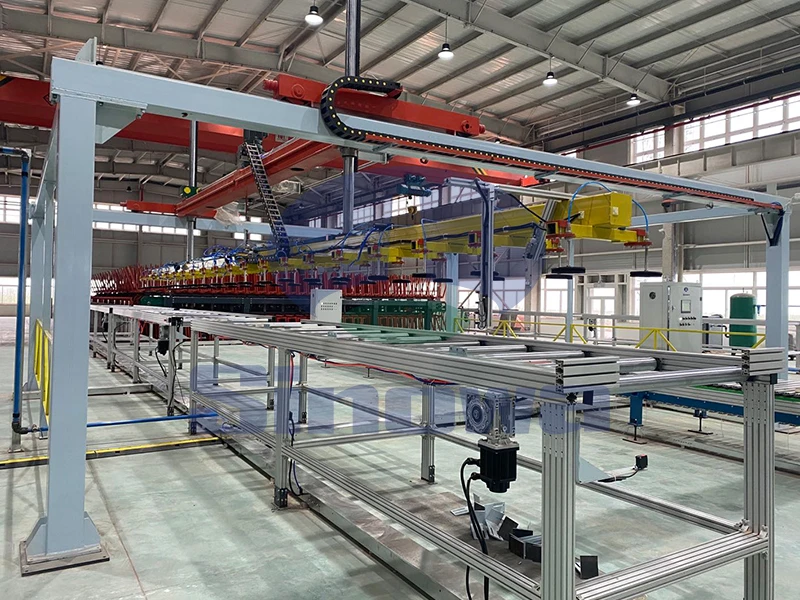
The conveyor system is the silent backbone of a polyurethane sandwich panel production line. While operators and managers tend to focus on the foaming machinery, the cutting stations, and the quality of the finished board, it is the network of belts, rollers, chains, and drives that carries every panel from the moment the facings are uncoiled until the finished product is stacked for dispatch. A panel line rarely fails because the dosing unit suddenly stops working; it fails, more often, because a conveyor belt has drifted a few centimeters, a roller has seized under a buildup of cured foam, or a drive chain has stretched beyond acceptable limits. The consequences of such small failures are disproportionately large: a single unscheduled stop can idle an entire shift, waste the reagents already mixed in the dosing head, and force the plant to rework or scrap a run of panels. Understanding how to maintain this equipment is therefore not a secondary concern but a core operational discipline, and it deserves the same rigor as the chemistry that produces the panels themselves.
The first layer of maintenance is a well-structured inspection routine that distinguishes between what can be seen, what can be felt, and what can only be measured with instruments. Daily checks should be brief but systematic, covering the obvious signs of trouble: unusual noise from bearings and gearboxes, excessive vibration in drive assemblies, visible wear on belt surfaces, and the accumulation of debris around idlers and return rollers. Because the operating environment of a sandwich panel line is unusually hostile—filled with residual foam dust, release agents, and the fine particles that are continuously shed from the facings—a quick daily sweep is not enough. The weekly inspection should go deeper, examining belt tension at every tensioning station, checking the alignment of all rollers against the centerline of the conveyor, and verifying that chains have not developed excessive slack or tight spots. The monthly routine extends further still: gearboxes should be sampled for oil condition, bearings should be checked for play, and the entire drive train should be re-torqued where bolted connections are known to loosen under cyclic load. The key discipline here is documentation. A maintenance log that records what was checked, what was found, and what was corrected becomes the single most valuable tool for predicting failure, because it turns random observation into a trend line that can be tracked over months and years.
Belt tension and tracking deserve special attention because they are the most common source of unplanned downtime on any panel line. A conveyor belt that is too loose will slip against the drive pulley, causing uneven speed, heating at the contact surface, and premature wear of both the belt and the pulley lagging. A belt that is too tight will strain the bearings and the belt carcass itself, leading to elongation and eventual failure long before its expected life. The correct tension is not a fixed value but a condition to be set and re-established over time, because every belt stretches slightly with use and the amount of stretch depends on temperature, load, and how often the line is started and stopped. Tracking—the tendency of a belt to wander to one side—is equally critical and almost always correctable through the same adjustment points. The rule of thumb that a belt moves toward the side where it meets the roller first remains valid, and small, incremental adjustments to the snub rollers and idlers will normally bring the belt back to center. The operator who resists the temptation to make large corrections, and instead makes a series of small adjustments with a measured pause between them, will achieve far better results than the one who cranks the tensioning screw in frustration. Because PU foam residue tends to build up on both the belt surface and the rollers, forming hard nodules that disturb tracking and cause localized pressure, the cleaning regime is inseparable from the alignment regime. No amount of careful adjustment will hold if the undersides of the belts and the faces of the rollers are not kept free of cured foam.
The roller and idler assemblies, which support the belt and guide the panel as it moves through the foaming and curing sections, present their own maintenance challenges. These components are exposed to the same hostile environment, and their failure mode is often a gradual seizing of the bearing rather than a sudden break. A seized idler no longer rotates with the belt; instead the belt drags across a stationary surface, generating friction, heat, and an increasingly deep wear groove. Because this failure develops slowly, it can go unnoticed for weeks while it quietly damages both the idler and the belt. The preventive answer is routine rotation of the idlers by hand during the weekly inspection, a five-second check that immediately reveals any bearing that has lost its free movement. Rollers that have been damaged, scored, or worn unevenly should be replaced rather than repaired, because a deformed roller will never track true again. In the curing section, where panels may travel on a double-belt conveyor, the alignment of the upper and lower belts relative to each other is critical to panel thickness uniformity; this alignment must be measured at regular intervals and corrected by shimming or repositioning the frame, since even a small misalignment will be translated directly into a thickness variation across the finished panel.
Chain-driven conveyors, commonly used in the heavier sections of the line where panels accumulate or where the load is too great for a belt, require a different set of disciplines. Chains are subject to elongation as pins and bushings wear, and a chain that has stretched beyond a certain point will no longer mesh cleanly with its sprockets, producing the characteristic jerky motion and characteristic clicking noise. This elongation should be measured periodically rather than judged by feel, because the eye is a poor instrument for detecting a change of only a few millimeters over a chain that may be many meters long. Regular lubrication is essential, but the type and quantity of lubricant matter as much as the frequency; a chain that is over-lubricated will fling oil onto the facings and contaminate the panels, while an under-lubricated chain will wear rapidly. Sprocket teeth should be inspected for the hook-shaped wear pattern that indicates the chain has been running too loose, and both chain and sprockets should be replaced as a matched set rather than individually, because a new chain on a worn sprocket will fail quickly. Chain tension should be maintained within the manufacturer's recommended slack, and the tensioning devices—whether jockey sprockets, adjustable idlers, or take-up frames—should move freely and be locked securely once set.
Drive components—the motors, gearboxes, couplings, and frequency inverters that actually power the conveyors—are the most expensive items on the line to replace, and their maintenance is largely a matter of protecting the lubricant and managing the thermal load. Gearboxes should be checked for oil level, oil quality, and leakage on a schedule that reflects the severity of the operating environment, and the oil should be changed at the intervals recommended for the service conditions rather than for ideal conditions. Overheating is the great enemy of the drive system: a gearbox that runs hot will oxidize its lubricant, lose its viscosity, and fail catastrophically in a way that a well-lubricated unit would never experience. The cooling fins of gearboxes and the ventilation of motor enclosures should be kept clean of foam dust, which acts as an insulating blanket and accelerates the temperature rise. Couplings should be checked for misalignment, which, if allowed to persist, will transfer damaging loads to the motor bearings and the gearbox input shaft. The frequency inverter, where fitted, controls the speed of the conveyor to match the line rate, and its maintenance is largely electrical: connections should be re-torqued, cooling fans checked, and the cabinet kept free of dust. Electrical maintenance, in fact, should never be separated from mechanical maintenance in the planning process, because many so-called mechanical failures are actually triggered by an intermittent electrical fault, a loose connection, or a failing sensor that caused a momentary speed change and a subsequent mechanical shock.
Sensors, limit switches, and the control system form the nervous system of the conveyor, and their maintenance is frequently neglected precisely because they appear to require no upkeep. Yet a photocell obscured by a thin film of release agent, a proximity switch that has drifted out of range, or a limit switch whose lever has become stiff will cause exactly the kind of intermittent misbehavior that is hardest to diagnose: a conveyor that stops at random moments, a panel that fails to advance, a stacker that misfires. Cleaning these devices is as important as cleaning the belts, and the cleaning schedule should be written into the routine rather than left to chance. The integrity of cables, connectors, and junction boxes should be checked periodically, because vibration and thermal cycling will loosen connections and allow moisture or foam dust to enter. When a fault does occur, the diagnostic process should be disciplined: observe the symptom, consult the alarm history, and work backward from the effect to the cause rather than simply resetting the system and hoping the problem disappears. Every unexplained stop that is cleared without identifying a root cause is a warning that has been stored up for the future, and a culture that values finding the cause over getting the line running again will pay dividends in reduced downtime over the long term.
Finally, and perhaps most importantly, maintenance is a human discipline as much as a technical one. The most sophisticated lubrication schedule, the most detailed inspection checklist, and the finest spare parts inventory are worthless if the people responsible for them are not trained, supported, and held accountable. Every operator who runs the line should understand the basic principles of belt tracking, the importance of cleaning, and the difference between normal wear and incipient failure, because the operator is the person present at every moment when a problem first begins to show. Maintenance staff should be trained not only in how to perform each task but in why it matters, so that they can prioritize correctly and recognize the early signs of trouble. Spare parts management is equally a human function: a stock of belts, idlers, chains, sprockets, bearings, and seals must be planned around the known wear life of each component, and the inventory must be checked regularly so that a critical spare is not found to be missing exactly when it is needed. The final element is review. A panel line that records its failures, analyzes their causes, and adjusts its maintenance plan in response will steadily reduce its downtime; a line that treats every breakdown as an isolated event will repeat its mistakes forever. The conveyor system, maintained in this way, becomes not a source of recurring trouble but a dependable, predictable asset that allows the entire production line to operate at its intended capacity, delivering panels of consistent quality shift after shift.
Tags: pu sandwich panel line, pu sandwich panel line manufacturer, pu sandwich panel line supplier, china pu sandwich panel line, pu sandwich panel line for sale